
Single Knee vs. Both Knee Replacement Cost: Which Is Better?
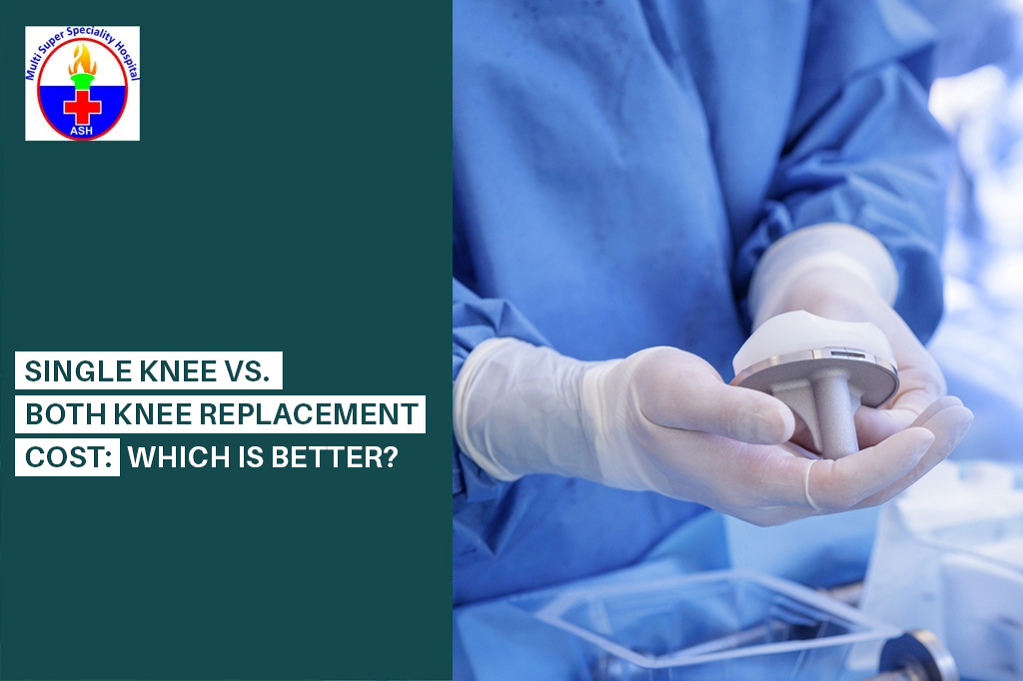
Suppose you wake up, and what you experience is not the floor beneath your feet, but some localized sharp pain in your joints. This is not a bad morning to millions of people, but their daily life. Chronic knee pain is not only painful, but it makes your life miserable. It causes you to skip the morning walk, the stairs and eventually lose the precious moments of life.
After conservative treatment such as physiotherapy or injections have failed, then you are at a crossroads of big proportions, that is, knee replacement surgery. This is where the actual dilemma begins. When you are so tired of one of your knees, do you replace one first or both at the same time? Is Double Knee Replacement really two times pricier or does it provide a hidden bargain?
It is easy to get lost in these medical and financial waters. This is the reason why we have compiled this detailed guide. We will raise the veil on costs, recovery, and clinical outcomes with the help of Dr. Rishi Sanghavi, an MS (Ortho) Gold Medalist and a veteran of over 7,000 orthopedic surgeries.
Defining the Options: Unilateral vs. Bilateral
We must first know what it is before we discuss the “how much” of it. Two major routes of patients with dual-knee arthritis exist in the field of orthopedics:
1. Unilateral Knee Replacement (Single)
This is the normal practice whereby a surgeon will only replace one damaged knee joint. This is normally advised where the pain on one side is much more severe or you are already known to have some underlying health conditions (such as heart or lung problems) that make it safer to have a shorter surgery.
2. Bilateral Knee Replacement (Both)
This is a knee replacement on both knees. This can be done in two ways:
- Simultaneous Bilateral: Both knees undergo surgery in one procedure under a single dose of anesthesia.
- Staged Bilateral Means : after 3 days of 1st knee replacement under same admission
In the case of the majority of patients who are going to seek efficiency and spending reduction, bilateral surgery on the same day is the game-changer.
The Global Cost Gap: Why the World Is Looking at India
In terms of cost, the figures are usually shocking. A typical knee replacement costs as much as a luxury car in the Western health care system.
- In America or Europe: It may cost between 20,000 and 30,000 USD to have a single knee replacement. In the case of a double knee replacement, that figure is almost likely to be doubled, with the exception of the enormous expenses of long-term rehabilitation institutions.
- In India at Anand Surgical Hospital: We have another philosophy to work with. In our establishment, one can get a knee replacement at between 1,200 and USD 2,600.
Why is it so much more affordable here?
It does not concern less expensive materials. Actually, Dr. Sanghavi takes the same world-class, FDA-approved implants (like the ones from Zimmer Biomet or Stryker) that are utilized in the most reputable hospitals in both New York and London. The difference in the prices is based on the reduced administrative overheads, reduced cost of living of the medical personnel and simplified surgical procedure with a focus on high-volume excellence.
Detailed Cost Comparison: Single vs. Both
Assuming that you are a candidate for bilateral surgery, the economically soundest decision is to have both knees done simultaneously. Here is why:
1. The Anesthesia & OT Factor
When you step into an Operating Theater (OT) every time, all these are fixed costs, namely the sterilization, time of the surgical team, and anesthesia drugs. The setup costs are only incurred once by doing both knees simultaneously.
2. Hospital Stay and Room Charges
One knee replacement normally takes a 3-4 day stay. The duration of a stay could be increased by only one or two days with a double knee replacement. In case you do them independently (staged), you have to pay two different admissions, two different room fees and two different administrative fees.
3. Pre-Op and Post-Op Savings
Before every surgery, there should be a set of tests: blood tests, ECG, X-rays, and physician clearance. Having both knees simultaneously implies that you only perform (and pay for) a single round of preoperative screening.
4. The Physiotherapy Advantage
This needs professional physiotherapy to recover. Although there is more rehab involved during two knee rehabilitations, it is centered in one period. You do not need to spend on the second round of home-visit physio sessions six months later.
Is Both-Knee Replacement Right for You?
All are not candidates for simultaneous bilateral surgery. Dr. Sanghavi analyzes patients according to:
- General Fitness: Do you have the capacity of the heart and the lungs to support a more extended operation?
- Age: Although age is a mere figure, patients who are above 60 years are usually assessed more conservatively.
- Support System: Do you have someone at home to help you within the first two weeks?
- Bone Quality: Does the bone density have enough mass to sustain two new implants simultaneously?
Investing in Your Future
Single or double knee replacement is an economic compromise of health. Although the amount of money and time spent in performing the two knees simultaneously is more expensive initially, the savings in terms of money, time and physical therapy in the long run makes it the better option for those individuals who are medically fit to undergo it.
After all, it is not a surgery you are paying for. You are purchasing the right to walk your daughter to the altar, to travel globally, or to just take a stroll in the park without any pain. In Anand Surgical Hospital Pvt. Ltd., we integrate global experience with a clear-cut and reasonable cost system.
Ready to move without pain? Allow no year to pass by with stiff joints. Talk with Dr. Rishi Sanghavi to find out what procedure fits your body and budget.